
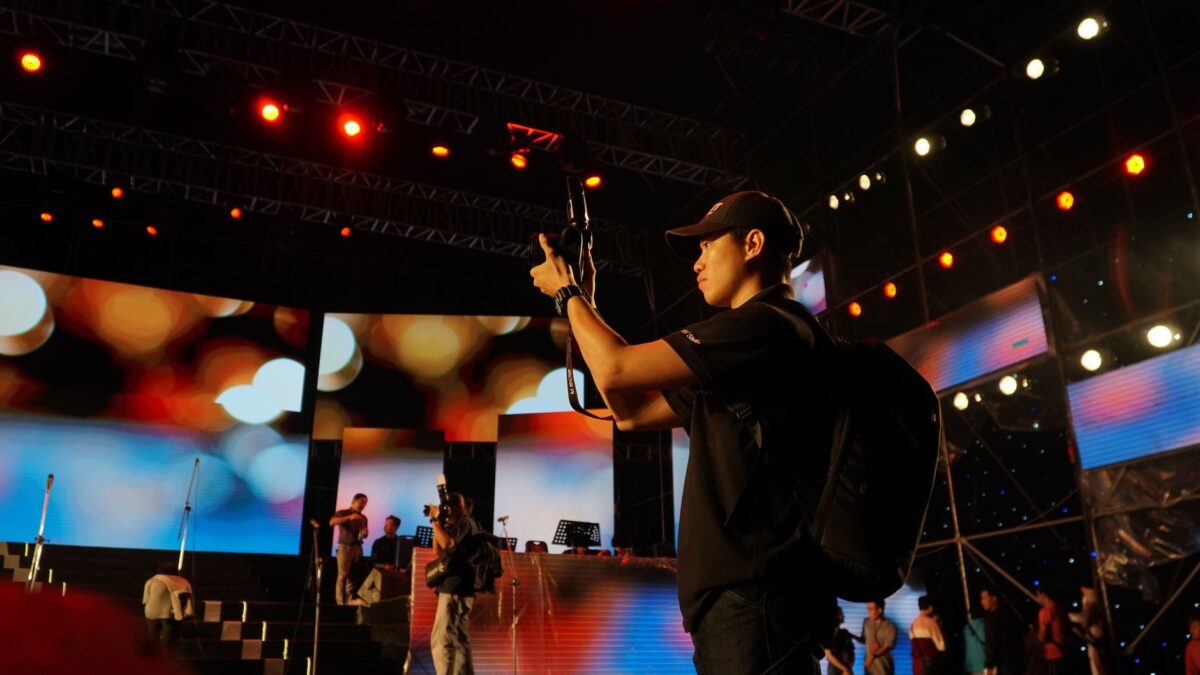
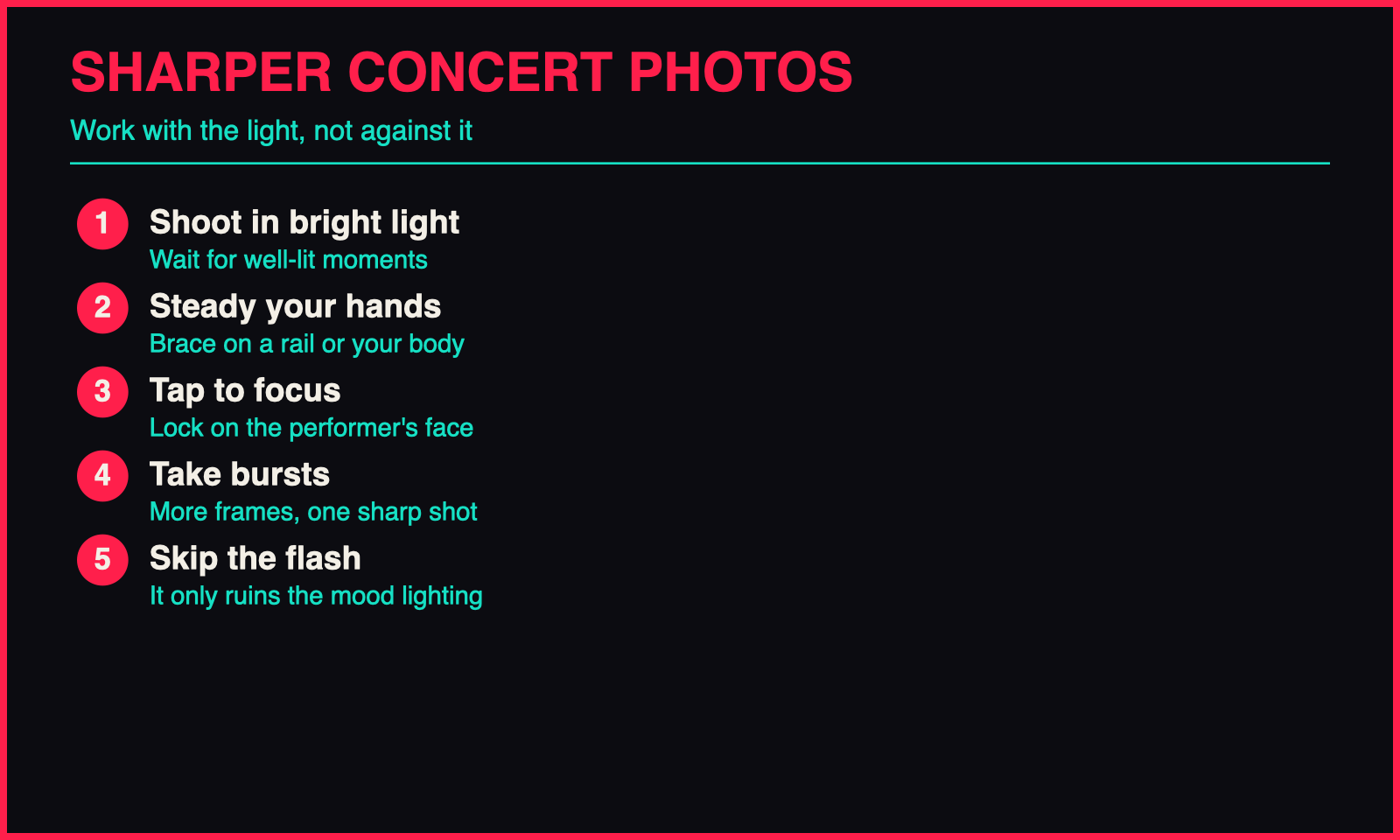
Getting a usable concert photo without a press pass comes down to five habits: shoot when the lights peak, brace your hands, lock focus on the performer’s face, fire off bursts, and leave the flash off. Concert photography for fans means capturing sharp shots in dark, fast-moving venues with whatever camera or phone you have on hand.
Low light, nonstop movement, and a packed crowd make a concert one of the toughest places to get a decent shot. Work with the light instead of fighting it, and you come home with photos that capture the night instead of a blurry orange smear. This is what actually works for fans shooting without pro gear.
Why concert photos are so hard to get right
Venues run dark, performers never hold still, and the lighting rig shifts every few seconds. Live Nation reported more than 145 million fans across its 2023 events, and most of those photos now come from phones in the crowd, not press photographers. Pollstar’s 2023 year-end report tracked a record $9.17 billion from the top tours. More shows means more nights to practice, 2026 included.
Five habits for sharper shots
- Shoot on the bright moments. Wait for the well-lit hits in the set instead of fighting near-total darkness between songs.
- Brace yourself. Lean on a railing, plant your elbows against your ribs, whatever cuts the shake.
- Tap to focus on the performer’s face. Locking focus there is what makes a shot read as sharp.
- Shoot in bursts. A run of five or six frames gives you decent odds at one keeper.
- Leave the flash off. It won’t reach the stage from the crowd, and it flattens the mood lighting you’re trying to capture.
Phone or camera: what to adjust
Either one works, phone or dedicated camera, as long as you adjust for the dark.
| Gear | Key Tip |
|---|---|
| Smartphone | Lower exposure to avoid blown-out stage lights |
| Phone night mode | Best for slower songs when subjects hold still |
| Mirrorless / DSLR | Raise ISO and use a fast shutter to freeze motion |
| Any zoom | Use optical zoom only; digital zoom destroys quality |
Many venues turn away professional cameras with detachable lenses unless you’re on a photo pass. Our concert packing checklist covers what gear clears the door.
Composition that captures the room
The best concert photos are about feeling, not just getting the artist’s face in frame. Work in the stage lights, the crowd silhouettes, a hand reaching up toward the stage: these tell the story of the night better than a tight close-up ever will. Wide shots that take in the whole scene usually beat zoomed-in portraits. The heaviest lighting tends to land during the biggest songs, and knowing how setlists are made helps you predict those peaks and have the camera ready before the drop.
Shoot without being that person
Don’t hold a raised phone up for an entire song and block the view behind you, and keep your screen brightness down so it doesn’t wreck someone else’s night vision. Grab a few frames, then put the camera away and watch the show. The same courtesy that keeps mosh pit etiquette workable applies here too. For the full plan on getting through a show, see our concert survival guide, and pair these techniques with our guide on what to wear to a rock concert.
Frequently asked questions
How do I take good concert photos on my phone?
Turn the exposure down to tame bright stage lights, tap to focus on the performer, shoot in bursts during well-lit moments, and brace your hands to cut blur.
Why are my concert photos always blurry?
Low light forces a slow shutter, and a slow shutter reads motion as blur. Shoot during the bright stretches, steady your hands, and let burst mode grab you a sharp frame.
Can I bring a real camera to a concert?
It depends on the venue. Many venues ban professional cameras with detachable lenses unless you have a press pass, so check the venue’s policy first; point-and-shoots and phones are almost always fine.
Should I use flash at a concert?
No. Flash can’t reach the stage from the crowd and only wrecks the atmospheric lighting. Lean on the stage lights and your camera’s low-light settings instead.
The bottom line
Good concert photography comes down to working with the light, steadying your hands, and shooting for the energy of the room instead of just the band. Use whatever gear you have, stay considerate of the people around you, and you will walk out with photos that actually put you back in that room.