

Wireless in-ear monitors free performers from cables by sending a personal audio mix over a radio or digital link to a small bodypack receiver. They give musicians the freedom to roam the stage while still hearing exactly what they need.
Anyone who has watched a frontline singer prowl an arena stage has seen wireless in-ear monitors at work. No cable tethers them to the floor, yet they still hear a clean, custom mix. This guide walks through how wireless IEM systems work, where they tend to fail, and how to pick the right one. For the basics of the earpieces themselves, start with our complete guide to in-ear monitors.
How a Wireless IEM System Works
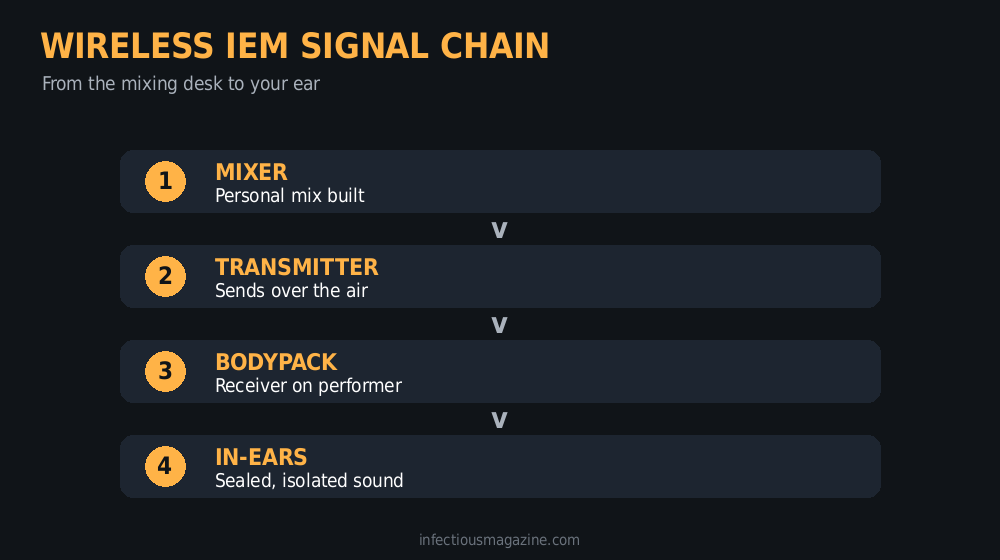
A wireless IEM system has three parts: a transmitter that sits near the mixing desk, a bodypack receiver clipped to the performer, and the in-ear monitors themselves. The transmitter sends the personal mix over the air, the bodypack picks it up, and the earpieces deliver it. The goal is mobility without giving up the tight, isolated mix that monitoring requires.
Frequency Bands and Interference
Most professional systems run on UHF radio frequencies. Newer digital systems lean on the 2.4 GHz band, the same one shared with Wi-Fi. UHF tends to hold up better over distance, though licensed spectrum for it keeps shrinking. 2.4 GHz costs nothing to license but can get crowded fast at a busy venue. Put several performers on one stage and each needs their own clear channel, which is why frequency coordination is a real job on big tours, not an afterthought.
Latency, Sound Quality and Fit
The biggest worry with anything wireless is latency, the tiny delay between sound and signal. Good systems keep that delay low enough that performers never notice it mid-song. Sound quality still comes down mostly to the earpieces and the seal, so a poor fit will undercut even an expensive transmitter. As with any IEM, isolation lets musicians monitor at lower, safer volumes, which matters given how loud stages get, a theme we cover in our guide to what to bring to a concert.
- UHF systems stay stable over distance, but licensed spectrum keeps shrinking.
- 2.4 GHz digital rigs are license-free and simple to run, though busy venues can crowd the band.
- Latency needs to stay low; a well-built system keeps it imperceptible.
- The seal still decides the sound, no matter how good the transmitter is.
Wireless Monitoring in 2026
Wireless monitoring is now standard from clubs to stadiums. Industry figures reported in 2026 show that live music revenue has rebounded to record levels worldwide, fuelling demand for reliable stage gear. At the same time, public health bodies warn that more than a billion young people are at risk of hearing loss from unsafe listening, which makes the lower safe volumes of a well-fitted IEM valuable for performers and crew alike. Singers often reach for specialised setups, covered in our guide to in-ear monitors for singers.
Frequently Asked Questions
Are wireless in-ear monitors worth it?
For performers who move around the stage, yes. Wireless IEMs offer freedom of movement and a clean personal mix. For stationary use or critical studio listening, a wired system can be more reliable and often cheaper.
Do wireless in-ear monitors have latency?
They carry a very small delay, but quality professional systems keep latency low enough that performers do not perceive it during a show.
What frequency do wireless IEMs use?
Most professional systems use UHF radio frequencies, while many newer digital systems operate on the licence-free 2.4 GHz band shared with Wi-Fi.
Conclusion
Wireless in-ear monitors give performers freedom without giving up the clean, isolated mix that monitoring demands. Get the frequency band, latency, and fit right, and a wireless rig performs like a wired one, just without the cable underfoot.