

In-ear monitors help singers hear their own voice clearly on a loud stage, stay in tune and protect their hearing. The right mix, plus a proper seal, can turn a chaotic gig into a controlled performance.
Singing on stage is hard when you cannot hear yourself. Floor wedge speakers fight a losing battle against the band, the crowd and the room. In-ear monitors solve that by sending a personal mix straight into the ear canal. This guide covers why singers use IEMs, how to set one up, and the common pitfalls to avoid. For the fundamentals, our complete guide to in-ear monitors covers how IEMs work.
Why singers switch to IEMs
A vocalist’s biggest enemy on stage is pitch drift, and pitch drift usually comes from not hearing yourself clearly. IEMs put your voice right where you need it, sealed off from the wall of noise around you. They also protect your hearing, since you no longer have to crank a wedge speaker to compete with a loud drummer. The payoff is steadier pitch, less vocal strain and a calmer night on stage.
Setting your monitor mix
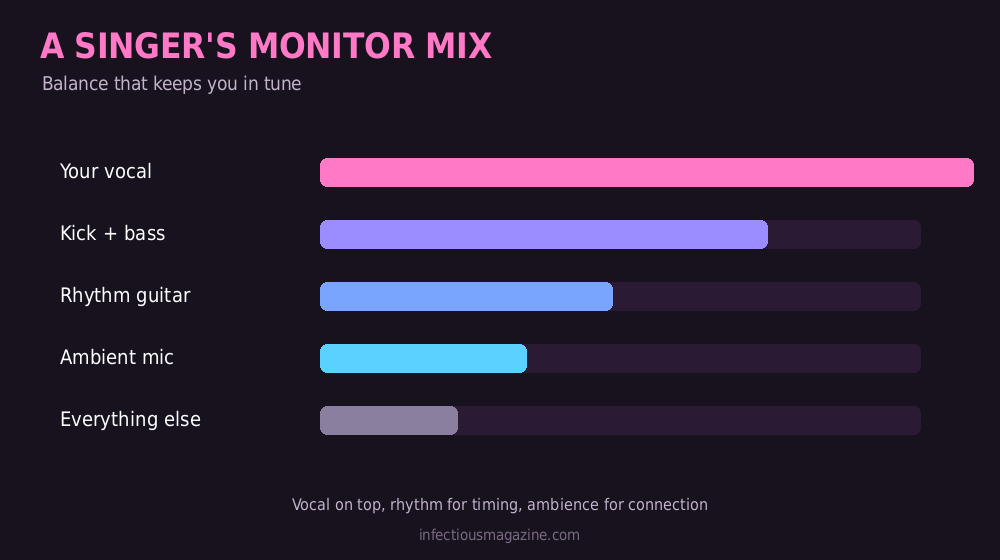
The mix is everything. Most singers want their own voice loud and clear, with just enough of the band, especially the rhythm section, to lock in time. Too much of everything and the mix turns to mush; too little and you feel disconnected from the song. Start with vocals on top, add the kick and bass for timing, then bring in whatever else you personally cue off. A custom mix per performer is the whole advantage of in-ear monitoring over a shared wedge.
The isolation problem and ambient mics
A sealed earpiece can feel too isolating, cutting you off from the crowd and the room around you. Many singers fix this with an ambient microphone that feeds a little crowd noise back into the mix, so the live connection does not disappear. Others simply run one ear out for the same reason, though that exposes them to raw stage volume again. Wireless freedom helps a lot here too, which is why many vocalists pair their earpieces with a wireless in-ear monitor system rather than staying tethered to a beltpack cable.
- Set your own vocal on top so it never gets buried under the band.
- Bring in kick and bass from the rhythm section to lock in the timing.
- Add an ambient mic so crowd energy does not vanish behind the seal.
- Get a custom-molded earpiece for the best seal and the most comfort over a long set.
If you are building out a wider at-home listening setup too, our comparison of studio vs. audiophile headphones covers the other side of the gear question.
Protecting your voice and hearing in 2026
Hearing protection is no longer optional for working musicians. Public health researchers have warned repeatedly that more than a billion young people are at risk of hearing loss from unsafe listening levels, and touring singers stack nightly stage volume on top of that risk. Well-fitted IEMs let them monitor at lower, safer levels without losing themselves in the mix. The live sector is booming, too: industry figures reported in 2026 show live music revenue has climbed back to record highs, which means more singers are on bigger, louder stages where good monitoring matters most. For the wider kit, see our guide to the best concert earplugs for protection off stage.
Frequently asked questions
Why do singers wear in-ear monitors?
Singers wear IEMs to hear their own voice clearly over a loud stage, which helps them stay in tune, reduce vocal strain and protect their hearing from damaging stage volumes.
Should singers use one or two in-ear monitors?
Two earpieces give the best isolation and protection, but some singers run one out to stay connected to the crowd. A better fix is usually an ambient microphone worked into the mix instead.
Do in-ear monitors help you sing in tune?
Yes. Hearing your own voice clearly and consistently makes it far easier to control pitch, which is one of the main reasons vocalists switch from floor wedges to in-ear monitors.
Conclusion
For singers, in-ear monitors are the difference between fighting the stage and owning it. A clear vocal, a smart mix and a good seal protect both your pitch and your hearing, so you can focus on the performance instead of straining to hear it.