
Alternative rock is guitar-driven music that grew out of the 1980s American underground and UK college-radio scene, valued for its independent attitude more than any single sound. It started as a label for bands too odd for mainstream radio, then went on to birth grunge, Britpop and modern indie rock.
The word “alternative” described where a band’s records got played, not how they sounded. College stations and small labels carried acts that commercial radio wouldn’t touch, and by the early 1990s that fringe status had turned into one of the biggest commercial forces in music. This guide walks through how alternative rock evolved, era by era, and the bands that defined each stretch. Pop-punk grew up in the same clubs and college towns; our guide to pop-punk bands covers that parallel story.
What “alternative” really means
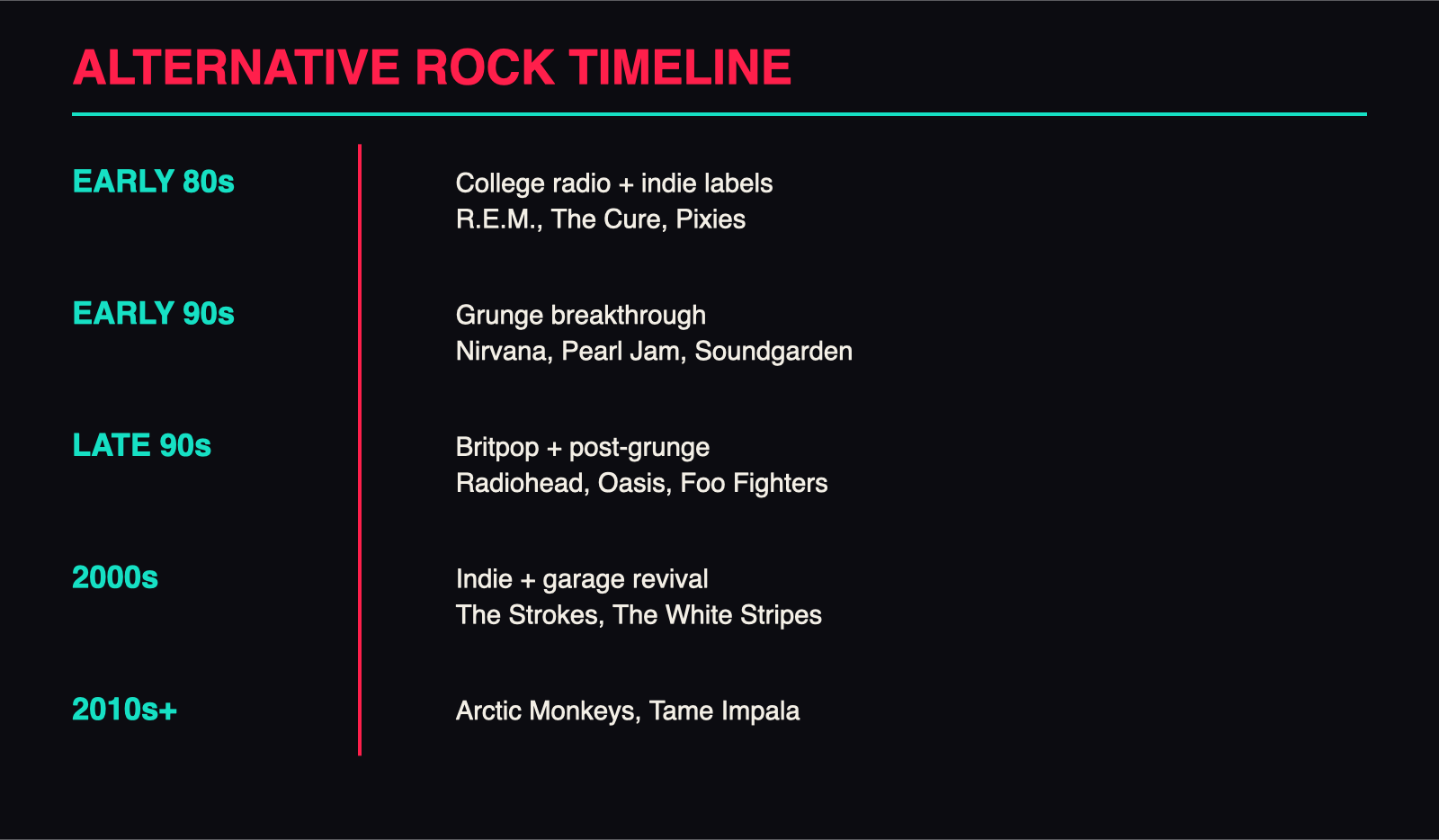
Through most of the 1980s, alternative rock simply meant whatever wasn’t on commercial radio. R.E.M., The Cure, the Pixies and Husker Du built loyal followings through relentless touring and word of mouth rather than airplay. Their records ranged from jangly guitar pop to gothic gloom to noisy art-punk, so the label never pinned down a genre so much as an attitude: outsider, do-it-yourself, inherited straight from punk.
The grunge explosion
That changed fast in 1991. Nirvana’s Nevermind, carried by “Smells Like Teen Spirit,” pushed Michael Jackson off the top of the Billboard 200 and showed that underground rock could win over a mainstream audience. The RIAA has certified the album Diamond, for more than 10 million U.S. copies sold. Alternative was suddenly the biggest thing in music. Pearl Jam, Soundgarden and Alice in Chains carried the Seattle grunge sound into arenas, and the alternative tag itself stretched to cover almost any rock band with an indie pedigree.
Britpop, post-grunge and the late ’90s
As grunge cooled, the late 1990s pulled alternative in several directions at once. In Britain, Oasis and Blur led the Britpop movement; Oasis’s (What’s the Story) Morning Glory? became one of the best-selling albums in UK chart history. Radiohead steered the genre toward experimental art-rock, while Foo Fighters turned post-grunge into stadium-sized anthems. By the end of the decade, “alternative” had its own Grammy category and its own radio format.
Indie revival and where it stands now
The 2000s brought a garage-rock and indie revival led by The Strokes, The White Stripes and Arctic Monkeys. From there the alternative umbrella kept splitting further, into indie pop, psychedelia and bedroom rock, with acts like Tame Impala carrying that restless spirit into the streaming era. Heading into 2026, “alternative” still works as shorthand for guitar music that sits outside the pop mainstream, even as the sound underneath it keeps shifting. Some of that era’s dreamier, more textural side lives on in shoegaze bands, which shared festival bills with alternative rock throughout the ’90s.
A few bands mark the turning points here. R.E.M. built the template as college radio’s first breakout act, Nirvana carried alternative to No. 1, Radiohead spent decades redefining what a rock album could sound like, and The Strokes lit the spark for the 2000s indie revival. Our piece on where scene bands are now picks up several of those later threads.
Heavier offshoots of the same scene fed into the bands covered in our explainer on post-hardcore, screamo and metalcore.
Frequently asked questions
Is alternative rock the same as indie rock?
They overlap heavily. Indie rock originally described music released on independent labels, while alternative became the wider commercial umbrella. The two terms get used interchangeably now, though indie usually still implies a smaller, more underground scale.
Is grunge a type of alternative rock?
Yes. Grunge is a subgenre of alternative rock that came out of Seattle in the late 1980s, mixing punk energy with heavy-metal sludge and introspective lyrics.
What was the first alternative rock band?
There is no single first band, but R.E.M., the Pixies and The Cure are usually named as the most influential early architects of the sound in the 1980s.
Why is it called “alternative”?
The term described music that offered an alternative to mainstream commercial radio. It lived on college stations and independent labels before crossing over into the mainstream in the early 1990s.
The bottom line
Alternative rock was never really one sound. It is guitar music made on its own terms, built by bands who didn’t wait for mainstream radio’s approval before finding an audience. From R.E.M. to Arctic Monkeys, those bands kept reshaping what popular rock could be, era after era.