

Post-hardcore, screamo and metalcore all trace back to hardcore punk and lean on screamed vocals, but the resemblance stops there. Post-hardcore favors melody and dynamic swings, screamo goes for raw emotional chaos, and metalcore welds hardcore aggression to heavy-metal riffs and breakdowns.
To outsiders, all three sound like the same wall of screaming. Fans hear three distinct worlds, each with its own pioneers, unwritten rules and pet peeves about being lumped in with the others. This guide untangles them so you can tell a breakdown from a catharsis at a glance. All three overlap with the scene covered in our pop-punk bands guide, where sung melodies and screams often shared the same stage.
How the three genres compare
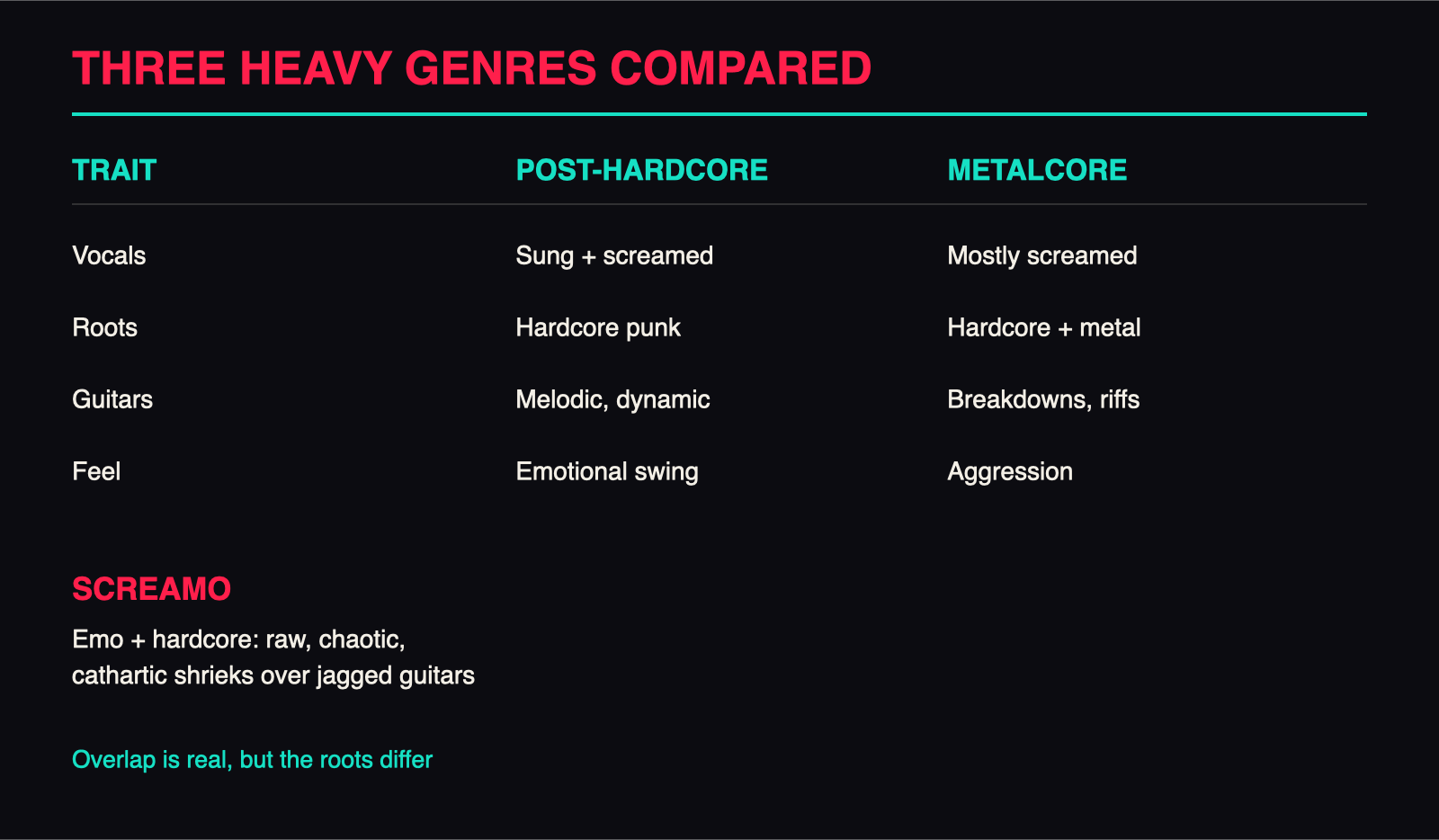
The fastest way to tell these genres apart is by what each one chases. Post-hardcore chases dynamics and melody. Screamo chases raw emotion, and often welcomes the chaos that comes with it. Metalcore chases heaviness and precision. All three descend from 1980s hardcore punk, a genre that sits within the wider alternative rock family tree, but each branch grew toward a different goal once it split off.
Post-hardcore: melody meets aggression
Post-hardcore emerged in the 1980s with bands like Fugazi and Rites of Spring, who kept hardcore’s energy but layered in musical complexity and a wider emotional range. By the 2000s, the genre had grown a melodic, more radio-friendly wing led by bands such as Thursday, Underoath and Sleeping With Sirens, who traded soaring clean vocals against screamed sections within the same song. The result swings between beauty and brutality, sometimes inside a single chorus. We cover one of its biggest names in our Sleeping With Sirens feature.
Screamo: raw emotional catharsis
Screamo formed in the early 1990s as an offshoot of emo and hardcore, and purists still call it “skramz” to separate it from the more commercial bands who borrowed the label later on. Pioneers like Orchid and pg.99 played short, chaotic songs built on jagged guitars and desperate, shrieked vocals. Metalcore is controlled; screamo is not, and that lack of polish is the point, since the genre prizes emotional release over precision. The term eventually got applied loosely to any band with screaming in it, which still bothers longtime fans of the original sound.
Metalcore: hardcore plus metal
Metalcore is the heaviest of the three, welding hardcore punk’s intensity to heavy metal’s guitar riffs and the genre’s signature move: the breakdown, a slowed, crushing passage built for moshing. Killswitch Engage, As I Lay Dying and Parkway Drive defined the modern sound, and metalcore became one of the most commercially successful heavy genres of the 2000s and 2010s. Acts like Bring Me The Horizon have since crossed into the mainstream charts. Heading into 2026, metalcore is still a festival staple worldwide.
- Post-hardcore signposts: clean-to-scream vocal swaps, melodic choruses, dynamic shifts.
- Screamo signposts: short songs, raw production, relentless emotional screaming.
- Metalcore signposts: palm-muted metal riffs, double-kick drums, the breakdown.
These heavier styles all shared festival bills with pop-punk and emo, especially on the tour covered in our history of Warped Tour.
For the chugging breakdowns and screamed-then-sung choruses, our breakdown of what makes metalcore tick goes further into the style.
Frequently asked questions
Is screamo the same as emo?
No. Screamo grew out of emo and hardcore but is far more aggressive and chaotic, built around screamed vocals. Traditional emo leans on melodic, often sung emotional songwriting instead.
What is the difference between post-hardcore and metalcore?
Post-hardcore is rooted in hardcore punk and emphasizes melody and dynamics. Metalcore adds heavy-metal riffing and breakdowns, which makes it heavier and more aggression-focused.
What is a breakdown?
A breakdown is a slowed, heavy passage, most associated with metalcore, built to create maximum impact in a live mosh pit. It usually strips the song down to crushing rhythm guitar and drums.
Can a band belong to more than one of these genres?
Plenty do. Many bands blend all three, mixing melodic post-hardcore choruses with metalcore breakdowns and screamo intensity. Genre lines in this scene are notoriously blurry, and fans argue about them constantly.
The bottom line
Post-hardcore, screamo and metalcore are siblings, not twins. They share a hardcore-punk family tree and a taste for screamed vocals, but each one is chasing something different: melody, catharsis or sheer heaviness. Learn the signposts once, and telling them apart becomes second nature.