
Math rock is a guitar-driven rock subgenre built on odd time signatures, angular riffs and intricate, often tapped guitar work that favors complexity and precision over simple hooks. It grew out of the American post-hardcore underground in the late 1980s, and at its best it still sounds like rock music doing arithmetic out loud.
Where most rock locks into a steady 4/4 groove, math rock zigzags through unusual meters like 7/8 or 11/8, stopping and starting in ways that feel jagged on first listen and hypnotic once they click. The genre grew out of the late 1980s and 1990s underground and remains a cult favorite decades later, with a small but devoted circle of players and listeners who never left it behind.
What makes it “math”
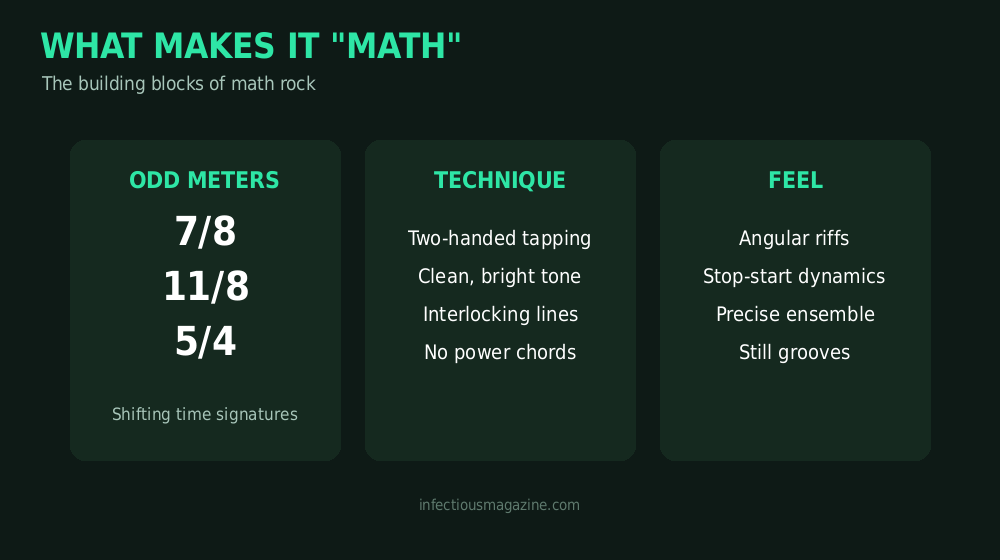
The “math” in math rock refers to its rhythmic complexity. Bands use shifting, odd time signatures and abrupt tempo changes that demand careful counting from both players and listeners. Guitarists often use two-handed tapping and clean, bright tones to play interlocking melodic lines instead of leaning on power chords. The result is technical and precise, but at its best it still grooves.
The origins of the genre
Math rock emerged from the American underground in the late 1980s and early 1990s, with bands like Slint, Don Caballero and Shellac laying the groundwork. Slint’s 1991 album Spiderland is often cited as a foundational record, and it influenced countless acts despite modest sales at the time. The genre drew on post-hardcore, prog and jazz fusion, sharing roots with the heavier scene covered in our explainer on post-hardcore, screamo and metalcore.
Key bands and the global scene
Beyond the American pioneers, math rock spread worldwide. Japanese bands like Toe and Lite built a melodic, emotional strain of the genre, while UK acts such as TTNG and Tubelord blended it with emo sensibilities. American group American Football bridged math rock and emo so successfully that their self-titled 1999 debut became a cult classic, later returning to the charts when reissued. That same emotional thread connects directly to midwest emo.
- Slint kicked off the sound with Spiderland, still the genre’s reference point.
- Toe carries the flag for Japan’s melodic wing of math rock.
- American Football built the bridge between math rock and emo.
- TTNG pair intricate guitar interplay with heartfelt vocals.
Math rock in 2026
Math rock remains a niche but resilient scene. Streaming has helped: industry figures reported in 2026 show that catalogue and niche genres now account for the majority of on-demand audio streams, giving cult bands a far longer shelf life than they had in the CD era. Vinyl has helped too, with sales growing for more than fifteen consecutive years according to 2026 reporting, and math rock reissues finding dedicated collectors along the way. The genre’s dreamier side also overlaps with shoegaze bands, sharing a love of texture and atmosphere over straightforward hooks.
Find your delay times
Math rock lives and dies by timing. Use this free BPM delay calculator to lock your delays and reverbs to the tempo of any song:
BPM Delay Calculator
Enter your song tempo – get the matching delay and reverb times in milliseconds for common note values.
Formula: 1/4 note = 60000 / BPM. Dotted = ×1.5, triplet = ×2/3. Values rounded (ms / Hz).
Frequently asked questions
What defines math rock?
Math rock is defined by complex, odd time signatures, angular riffs and intricate guitar techniques like two-handed tapping. It favors rhythmic complexity and precision over conventional verse-chorus structures.
Is math rock hard to play?
Generally, yes. The odd time signatures, tapping techniques and tight ensemble timing make math rock technically demanding for musicians, and that difficulty is part of its appeal among players.
Is American Football a math rock band?
American Football blend math rock and emo. Their intricate, clean guitar interplay is rooted in math rock, while their emotional lyrics and melodies tie them to the emo scene.
Conclusion
Math rock asks a little more of its listeners, trading easy hooks for shifting rhythms and tangled guitar lines. Once those odd meters click into place, though, the payoff is hard to match. Start with Spiderland and American Football, then follow the genre as it spreads across the globe. For a curated roster, see our rundown of the best math rock bands across four decades.