
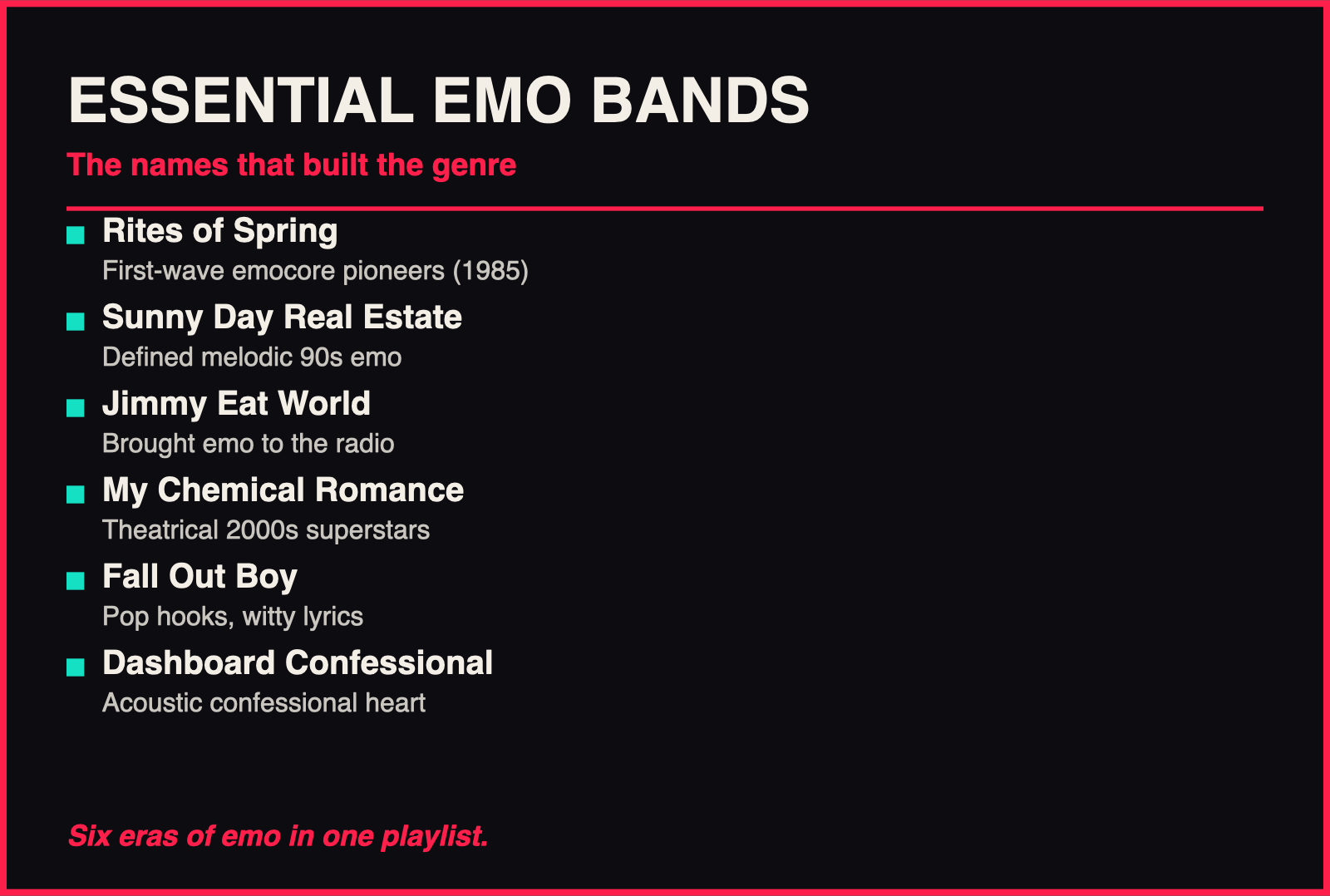
The essential emo bands are the artists who defined each wave of the genre, from D.C. hardcore pioneers Rites of Spring to 2000s superstars like My Chemical Romance and Fall Out Boy.
Emo split into several distinct eras over four decades, and the names that matter most shift depending on which one you mean. Below is a wave-by-wave rundown so you can hear how the sound changed shape. New to the genre? Start with our pillar explainer on what emo actually is, then circle back for the band-by-band tour.
The First Wave: Where It Started
Emo began in Washington, D.C. in the mid-1980s. Rites of Spring are widely credited as the first true emo band, taking hardcore’s fury and pointing it inward at personal pain instead of outward at the world. Embrace, fronted by Ian MacKaye, ran with the same emotional-hardcore template. Both bands stayed tiny in their day. Their influence did not.
- Rites of Spring: set the blueprint for confessional intensity.
- Embrace: emotional hardcore built by a punk legend.
- Fugazi: not strictly emo, but a crucial bridge between scenes.
The Second Wave: Emo Gets Melodic
By the 1990s, emo had grown actual tunes. Sunny Day Real Estate brought soaring, atmospheric melodies that shaped nearly everything that followed. The Promise Ring and Jimmy Eat World made the sound catchier and warmer, closer to pop songwriting than hardcore shouting. This is also the era of American Football, whose intricate, twinkly guitars launched a sub-style covered in full in our Midwest emo explainer.
The Third Wave: Emo Goes Mainstream
My Chemical Romance brought theatrical, conceptual albums to the 2000s and turned emo into a pop-culture phenomenon along the way. Fall Out Boy paired huge hooks with sharp, self-aware lyrics. Dashboard Confessional made acoustic confessionals an arena-sized event. Paramore became one of the era’s defining acts, full stop. This commercial peak gets a deeper look in our dive into 2000s emo and its revival.
| Band | Signature Album | Why It Matters |
|---|---|---|
| My Chemical Romance | The Black Parade (2006) | Emo’s theatrical masterpiece |
| Fall Out Boy | From Under the Cork Tree (2005) | Pop-emo crossover blueprint |
| Paramore | Riot! (2007) | Powerhouse vocals, scene anchor |
| Dashboard Confessional | The Places You Have Come to Fear the Most (2001) | Acoustic emo’s heart |
The scale of that moment is easy to underestimate now. My Chemical Romance’s The Black Parade has been certified multi-platinum by the RIAA, and Fall Out Boy’s mainstream breakthroughs sold in the millions during the genre’s commercial peak. A sound rooted in basement hardcore reaching numbers like that would have seemed absurd a decade earlier.
The Revival: Emo’s Modern Torchbearers
The 2010s brought a DIY revival led by bands like The Hotelier, Modern Baseball, and Tigers Jaw, each looking back to the second wave for inspiration. Their rise showed that emo’s audience was generational rather than a one-time nostalgia wave. Luminate’s 2024 Year-End Music Report showed catalog music continuing to dominate U.S. consumption, and emo’s deep back catalog keeps these revival bands in good company on streaming playlists heading into 2026.
Frequently Asked Questions
Who was the first emo band?
Rites of Spring, formed in Washington, D.C. in 1984, are widely considered the first emo band. They pioneered the confessional, emotionally intense style that defined the genre’s first wave.
Is My Chemical Romance emo?
Yes, although the band has often resisted the label. Their theatrical, lyrically dramatic albums made them the definitive emo act of the 2000s mainstream era.
Are Paramore an emo band?
Paramore emerged from the 2000s emo and pop-punk scene and are closely tied to it, though their sound has evolved well beyond emo over time. They remain one of the era’s most important acts.
Where should a beginner start?
Start with a few accessible classics: Jimmy Eat World’s “The Middle,” My Chemical Romance’s “Welcome to the Black Parade,” and Fall Out Boy’s “Sugar, We’re Goin Down.” Our roundup of the greatest emo songs makes a solid playlist starter.
The Bottom Line
Rites of Spring’s basement intensity and My Chemical Romance’s arena spectacle sit at opposite ends of the same story. Learn these names and you can hold your own in almost any scene conversation, then dig deeper through our guides to emo’s history and where some of the era’s rockers ended up.