
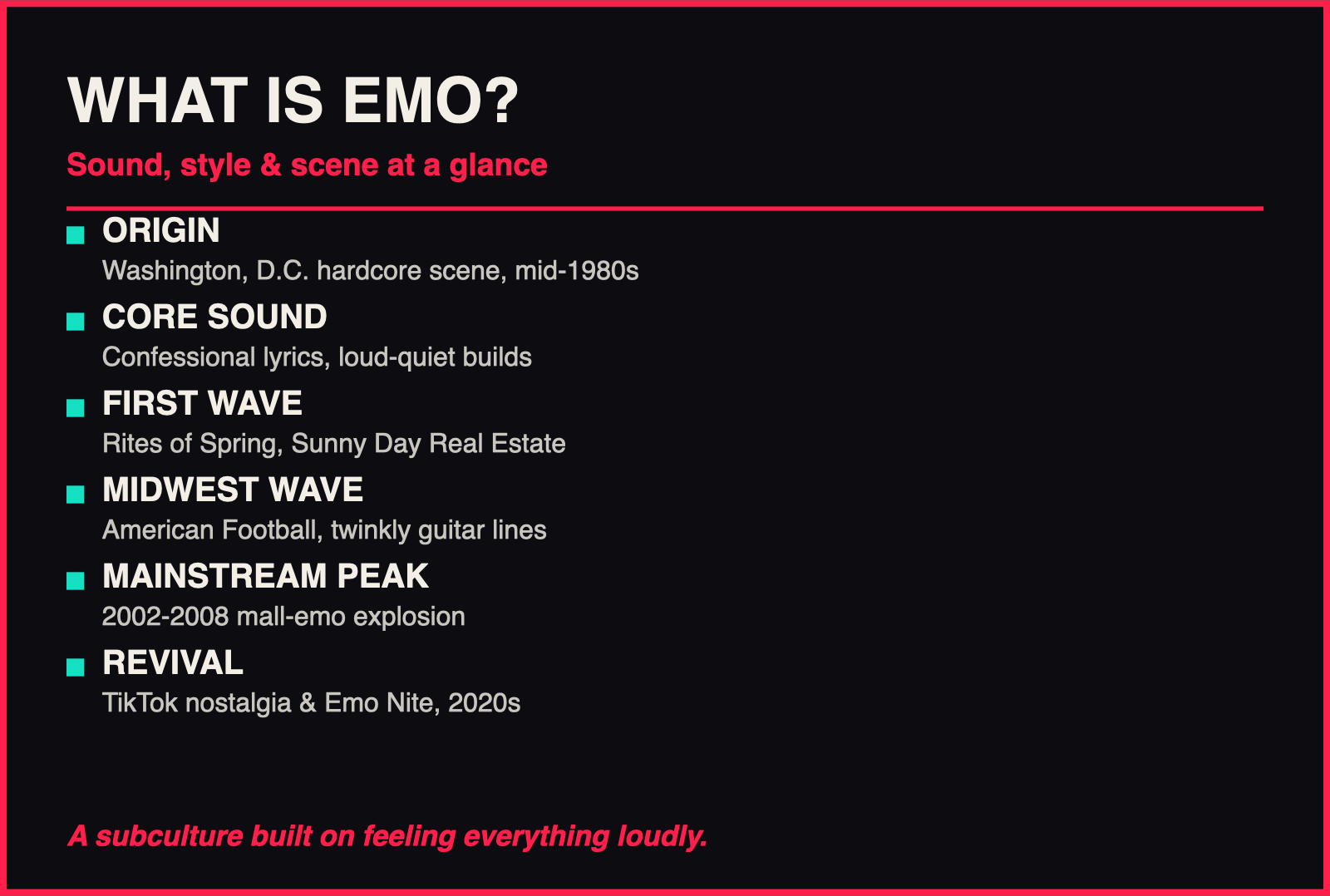
Emo is a melodic, emotionally raw offshoot of hardcore punk that emerged in the Washington, D.C. scene around 1985. Early bands turned hardcore’s aggression inward, swapping political anger for confessional lyrics and loud-quiet song dynamics. The result is music built for a tight-knit crowd that shouts heartbreak back instead of hiding it.
If you have ever screamed along to a chorus about a breakup until your voice cracked, you already understand the appeal. Emo is less a single sound than a feeling pushed through a guitar amp. Over four decades it has mutated from a tiny basement scene into a global aesthetic, but the heart of it never changed: honesty, volume, and the sense that someone out there feels exactly what you feel.
Where Emo Came From
Emo was born in the Washington, D.C. hardcore punk scene around 1985. Bands like Rites of Spring and Embrace took the speed and aggression of hardcore but pointed the anger inward, writing about personal pain instead of politics. Fans and critics began calling it “emotional hardcore,” soon shortened to “emocore” and finally just “emo.” The label stuck even though almost no band has ever liked it.
The first wave stayed underground, but a second wave in the 1990s gave emo its blueprint. Sunny Day Real Estate added soaring melodies, while The Promise Ring and Jimmy Eat World made the sound catchier. By the time the 2000s arrived, emo was ready for the mainstream. To trace that specific regional thread, our guide to Midwest emo and its twinkly sound covers the bands that bridged the gap.
What Emo Actually Sounds Like
Strip emo down and you find a few reliable ingredients. Guitars swing between gentle, clean arpeggios and crashing distortion. Vocals slide from a near-whisper to a full-throated shout, sometimes within a single line. Lyrics are diary-direct, often built around heartbreak, alienation, or self-doubt. The drama is the point.
- Quiet verses that explode into loud, distorted choruses without warning.
- Lyrics written in the first person, specific enough to feel like a diary entry.
- Melodic hooks built for a room full of strangers to scream back in unison.
- Two guitar parts weaving around each other instead of one riff carrying the song.
That formula proved astonishingly durable. The genre’s commercial peak came in the mid-2000s, when emo and pop-punk acts dominated radio and the Warped Tour. Streaming data shows the appetite never fully faded: according to Luminate’s 2024 Year-End Music Report, rock remained one of the most-consumed genres in the United States, and catalog rock from the 2000s continues to outperform much of the new music released each year.
Emo as a Subculture
Emo was never just music. By the mid-2000s it was a full identity: side-swept black hair, skinny jeans, studded belts, band tees, and eyeliner worn by everyone regardless of gender. If you want the full breakdown, our complete emo style and fashion guide walks through every signature piece.
The scene also lived online before most subcultures did. MySpace, founded in 2003, became emo’s town square, where bands like My Chemical Romance and Fall Out Boy built huge followings directly with fans. That early social-media muscle is part of why emo nostalgia spreads so easily today, from Emo Night dance parties to viral TikToks.
The Many Faces of Emo
“Emo” is an umbrella, not a single style. Knowing the branches helps you talk about it without starting an argument in a comment section.
| Strain | Vibe | Touchstone Era |
|---|---|---|
| Emocore | Raw, hardcore roots | Mid-1980s |
| Midwest emo | Twinkly, mathy guitars | Late 1990s |
| Mall emo / pop-emo | Polished, radio-ready | 2002-2008 |
| Screamo | Chaotic, scream-heavy | 1990s-2000s |
| Emo revival | DIY throwback | 2010s-2020s |
Each branch has its own canon, and fans love to debate the borders. To get oriented fast, start with our list of the essential emo bands every fan should know and the companion roundup of the greatest emo songs of all time.
Emo’s Comeback
Emo never really died, but it roared back in the 2020s. The When We Were Young festival, which sells out Las Vegas with a lineup of 2000s emo and pop-punk acts, proved the nostalgia economy was real. Pollstar’s year-end touring reports have repeatedly shown legacy rock and pop-punk tours posting strong grosses, and heritage acts from the era continue to fill arenas in 2026. Streaming numbers tell the same story: RIAA data shows streaming accounted for roughly 84% of recorded-music revenue in the United States in 2023, and that always-on access keeps decades-old emo anthems in constant rotation for new listeners.
Modern bands carry the torch too. For a sense of how the heavier side evolved, our explainer on metalcore and its breakdowns traces a sibling genre that grew up alongside emo. And if you came of age in the golden years, our look back at 2000s emo and its revival is built for you.
Frequently Asked Questions
Is emo a type of music or a fashion style?
Both. Emo started strictly as a music genre in the 1980s, but by the 2000s it had grown into a full subculture with its own fashion, hairstyles, and online community. Today people use “emo” to describe a sound, a look, or a mood.
Is emo the same as punk?
Emo grew directly out of punk, specifically hardcore punk, so they share DNA. The difference is focus: punk often aims its energy outward at politics and authority, while emo turns that same intensity inward toward personal feelings and relationships.
Why do people confuse emo and goth?
Both subcultures favor black clothing and a melancholic mood, so outsiders mix them up. The music, history, and attitudes differ a lot, though. Our guide on emo vs goth breaks down exactly how to tell them apart.
Is emo still popular in 2026?
Very much so. A major festival circuit, sold-out reunion tours, viral nostalgia on TikTok, and packed Emo Night events have all kept the genre thriving well into the 2020s and beyond.
Why Emo Still Hits
What started as a handful of bands rewriting hardcore’s rulebook in Washington, D.C. basements ended up shaping haircuts, festival lineups, and the soundtrack of two decades’ worth of breakups. Along the way the scene split into a dozen sub-styles: raw emocore, polished mall emo, twinkly Midwest riffs, and more. None of them ever fully replaced the others. They just moved in next door. Fans who grew up on the mid-2000s wave now bring their own kids to festivals like When We Were Young, while a younger crowd discovers My Chemical Romance and Fall Out Boy through a TikTok clip instead of MySpace. The way people find the music keeps changing, but a song that says the quiet part out loud still lands the way it always has.